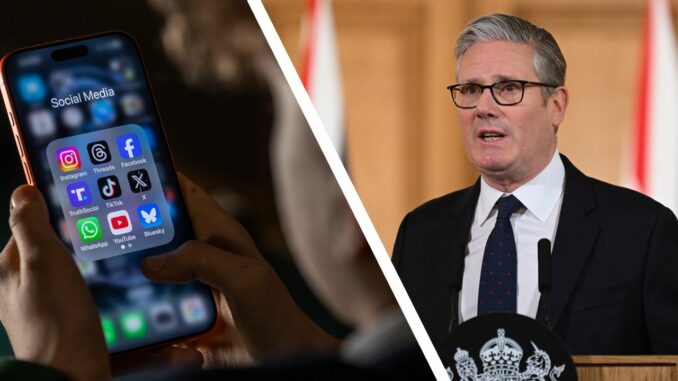
The UK has become the latest country to ban social media for under-16s, with Prime Minister Keir Starmer announcing today that “children will be given back their childhoods thanks to government action”.
Following Australia’s decision to lock teens out of popular social media apps in December 2025, the UK has promised “world-leading additional restrictions” on features like live streaming and strangers communicating with children.
The landmark legislation, which the UK government says is “backed by 9 in 10 parents”, is expected to be brought before Parliament before Christmas, and could then come into force in Spring 2027.
So how exactly will the social media ban work, and what does it mean for children in the UK? You can follow all of the latest updates here live…
UK social media ban — a quick primer
(Image credit: Getty Images)
Hello, and welcome to our liveblog on the UK’s landmark social media ban for under-16s.
We’ll be rounding up all of the latest news, reactions and more here today, but first a quick primer on what’s happened.
The UK announced the social media ban for under-16s this morning. The statement says that social media is “designed to be addictive” and that the restrictions will give mean “less time for scrolling and more time for play”.
The government says it will “use the same model for a social media ban as Australia” and that means the platforms will include Snapchat, TikTok, YouTube, Instagram, Facebook and X. It won’t include private messaging apps likes of WhatsApp and Signal.
If it’s passed by Parliament later this year, the ban is expected to come into force from Spring 2027.
Which platforms are affected?
(Image credit: Ka Han / Shutterstock)
The UK government’s statement lists some of the major platforms that will be affected by its proposed ban. These are
SnapchatTikTokYouTubeInstagramFacebookX
The UK government says that “we do not intend for messaging services like WhatsApp and Signal to be included in the social media ban”.
However, there are also planned restrictions for “so-called AI ‘romantic companion’ chatbots – designed to simulate sexual relationships or roleplay with users”, which will “have to enforce a minimum age of 18”.
The statement adds that “similar intimate functionalities will be restricted for under-18s on AI chatbots more widely”.
This is an ‘Australia plus’ ban
(Image credit: Getty Images)
As expected, the UK’s proposed social media ban for under-16s is following a so-called ‘Australia plus’ model. That means it’s following the thrust of Australia’s legislation by restricting access to social media apps for children, but also adding extra restrictions for platforms that aren’t banned.
The UK says this will include “world-leading blocks on harmful functions such as livestreaming and stranger communication with children for under-16s” and will affected “a wider range of online services, including on gaming sites”.
And that’s not it — the government says it will “also be looking in more detail at overnight curfews and breaks in infinite scrolling for under-18-year-olds”. Exactly how this might be implemented isn’t clear, which is why Prime Minister Keir Starmer has said the UK will “set out more detail in July”.
UK says it will “learn the lessons” of Australia ban
Reports have claimed that Australia’s social media isn’t proving very effective, with research from the Molly Rose Foundation claiming that over half of under-16 users were still on TikTok, YouTube, and Instagram.
The UK government says it will “learn the lessons from Australia’s experience” by introducing “more highly effective age assurance (HEAA) measures to support compliance, making it far harder for children to bypass safeguards”. Exactly what that entails, and how it will be balanced with privacy concerns, isn’t yet clear.
Ban is “backed by 9 in 10 parents”
(Image credit: Getty Images)
The UK government is pretty confident its social media ban for under-16s has public support and will be passed by Parliament “before Christmas”.
It says the announcement follows “one of the biggest national conversations held by this government” with over “116,000 responses submitted by parents, children and experts across the country”.
In those responses, “9 in 10 parents said they would support a social media ban for children under 16s”, it said. Surprisingly, the government added that most “young people” also backed action” with “two-thirds agreeing that children younger than 16 should not be allowed to use at least some social media platforms”.
That said, it didn’t clarify exactly what it meant by “young people” and some inevitable controversy will arise more from its implementation than the broader idea.
How will the ban work?
(Image credit: Ofcom / Shuttertock / Fizkes)
The specifics of how the UK’s social media ban will work is down to the country’s communications regulator, Ofcom. The government says “Ofcom will conduct a rapid study on what is effective age assurance for verifying whether someone is over 16”.
Ofcom has said it’s been behind “some of the strongest changes” for online safety regulation, which includes porn sites being required to carry out age checks.
This means the UK social media ban will likely rely on technologies like digital ID and face scans — techniques that’ll no doubt kickstart another privacy debate. VPNs will also likely in the spotlight, given their role in allowing people to get around similar blocks.
Not everyone backs the ban
(Image credit: Getty Images)
The UK’s proposed social media ban for under-16s isn’t backed by all experts, despite the government’s confidence that it has public support.
Professor David Ellis, Chair of Behavioral Science at the University of Bath and a member of the Institute for Digital Security and Behavior, said: “This ban is based on worry, not evidence. The evidence base as it stands suggests social media has a minuscule effect, if any, on teenagers — particularly once you account for the other factors we know shape childhood development”.
“It’s also unlikely to be straightforward to enforce, given what we’ve seen elsewhere, and it risks pushing teenagers towards less regulated parts of the internet,” he added. “Worse, it lets social media companies off the hook: they can divert resources away from making platforms safer, despite the fact that many young people will simply remain on them”.
Is there more to come?
(Image credit: Pexels)
While the ban is currently aimed at under-16s, Children’s Commissioner Dame Rachel De Souza wants measures extended to 18-year-olds across several key areas.
“Any online service – not just social media, but gaming and other platforms – that uses harmful features should be banned from accessing under-18s unless and until it can prove it is safe.”
‘Harmful features’ is the term being used throughout this process, likely to allow further features to be added in the future should they be deemed applicable. That said, the Commissioner explicitly mentions addictive scrolling, explicit content, and unwanted strangers in her statement.
Measures surrounding under-18s are to be looked into in more detail in July. However, there’s currently nothing to suggest this will extend to a full ban like that enforced today.
Do you need to do anything?
(Image credit: Image Credit: TeroVesalainen / Pixabay)
Thankfully, for now, all you need to do is sit tight and wait for new information. The Government has said it will provide details to families and children ahead of the ban’s enforcement.
If you’re an adult, the ban will likely take a similar shape to the enforcement of the Online Safety Act age verification measures last year. This means that most likely, your account will automatically be deemed to comply if:
It’s been open for 16 years or longerit’s linked to an email account that can prove you are over 16A bank card is associated to the account that can prove your age
Should you be required to verify your age, it will likely use methods including ID checks, facial scanning, or bank card verification.
If you’ve already verified your age for services as a result of the Online Safety Act, you shouldn’t need to do them again either!
Will it work? Parents are split in polling
(Image credit: YouGov)
More responses to the UK government’s plan are coming in.
YouGov has just released a poll that shows while 77% of UK parents with children under 18 support the ban (a point over all Britons in general at 76%), only 45% think it will be very or quite effective at curbing social media use.
59% of the population as a whole think the ban will be not very effective at stopping under-16s from using social media.
Greens say offline support is needed
Green Party Leader Zack Polanski at a campaign rally in May 2026 (Image credit: Getty Images / Jon Rowley)
How are the UK’s other parties responding to the ban?
The UK’s Green Party has said it “welcomes action to address the harms social media can cause to young people. The impact on mental health and online safety is well documented as is the huge concern among parents, teachers and many young people themselves. Stronger safeguards are clearly needed.”
However it added, “organisations including the NSPCC and the Molly Rose Foundation have warned that a blanket ban could leave some young people, particularly disabled and LGBTQIA people, more isolated and cut off from support. We also need to see real investment in youth services and creative activities for young people to fill the void that will be created by this ban.”
This echoes the words of Lisa Nandy, the UK’s Secretary of State for Culture, Media and Sport, who said “Keeping children safe online must go hand in hand with giving them more opportunities offline.”
More UK party leaders weigh in
Sentiment among other parties and their leaders is spilt.
Kemi Badenoch, the Conservative party leader, has called the ban “fantastic news,” saying it’s “an important step in helping parents protect childhood for children.”
Meanwhile Liberal Democrat leader Ed Davey noted that while “families have been crying out for action to protect children from harmful social media” he and his party are “really worried that the government hasn’t listened, and has instead come up with a half-baked policy that won’t keep children safe.”
Reform UK leader Nigel Farage doesn’t think the ban will work “given the mass adoption of VPNs” adding that this move is “the introduction of Digital ID via the back door.” He instead says that “handsets for children with limited features” are the best option — suggesting he’s either yet another dumb phone fan, or isn’t entirely aware of modern phone’s parental controls like the ones Apple just added to iOS 27.
Meta and YouTube respond
(Image credit: Shutterstock)
Platforms are also sharing their thoughts on the UK’s plans.
Speaking to the media a YouTube spokesperson has said “YouTube is a vital resource for young people, educators and parents, external. Blanket bans push kids out of such curated, supervised, beneficial experiences and towards anonymous, less safe services.”
Meta (Facebook, Instagram, WhatsApp) has echoed YouTube’s response, adding that any targeted age based restrictions should be done on device “so people aren’t asked to hand over ID to dozens of individual services to prove their age.”
How will 16 and 17-year-olds prove their age?
When you’re trying to prove you’re over 18 there are a few methods like a driver’s licence or a credit card check that can be used to verify your age. For people aged 16 or 17 there are fewer options, and we’ll need to wait and see what Ofcom proposes they use as details of the UK government’s plans are hashed out.
Options they could use include provisional driver’s licences, bank account information, or passports if they have them.
Whatever verification method is proposed could go hand-in-hand with the UK’s legislation to lower the voting age from 18 to 16 by the next general election.
We have our first viral reaction
Everything about this clip is brilliant. pic.twitter.com/aMpsHokB8xJune 15, 2026
The mood in UK classrooms today appears to be somber, as this BBC report captures brilliantly.
First, the reporter asks under-16 students to raise their hands if they support the ban — a request that’s inevitably met by stunned silence.
Then, when asked what she will do instead of the nine hours per weekend she typically spends on social media, the student Isabella replies “stare at a wall”. It’s fair to say this isn’t going down well with many — and if you’ve grown up with social media and use it as a communications tool, that’s understandable.
Is the evidence really there?
(Image credit: Getty Images)
Is there any scientific evidence that social media use harms the brains of children? Not really, as academics told a Science, Innovation and Technology Committee this week.
Professor Denis Mareschal, who is the director of the Centre for Brain and Cognitive Development at Birkbeck College, said “There is very little, if any, causal research in the early years”.
And those views were echoed by University of Cambridge Professor Sarah-Jayne Blakemore, who said that the impact of “digital devices or social media” on adolescent brains amounted to “almost nothing”.
That’s not to say there’s no impact, of course, just that the data doesn’t yet support the theory that social media’s impact on young brains is causational, not just correlational.
Source: Latest from TechRadar US in Internet News
Leave a Reply