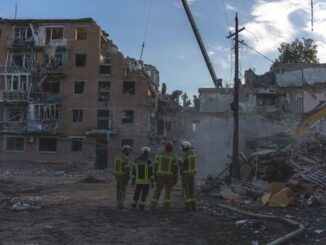
The UN Humanitarian Coordinator for Ukraine on Wednesday called for an end to attacks against civilians following further overnight strikes by Russian forces that reportedly killed at least 19 in the Chernihiv Region.
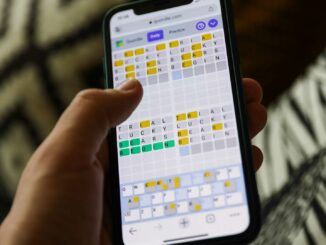
Looking for a different day? A new Quordle puzzle appears at midnight each day for your time zone – which means that some people are always playing ‘today’s game’ while others are playing ‘yesterday’s’. If you’re looking for Wednesday’s puzzle instead then click here: Quordle hints and answers for Wednesday, October 7 (game #1717). Quordle was one of the original Wordle alternatives and is still going strong now more than 1,500 games later. It offers a genuine challenge, though, so read on if you need some Quordle hints today — or scroll down further for the answers. Enjoy playing word games? You can also check out my NYT Connections today and NYT Strands today pages for hints and answers for those puzzles, while Marc’s Wordle today column covers the original viral word game. SPOILER WARNING: Information about Quordle today is below, so don’t read on if you don’t want to know the answers. Quordle today (game #1718) […]
Learn what teacher burnout is, its signs, causes, statistics, and effects on teacher attrition, plus evidence-informed strategies for prevention and recovery. This post was first published on eLearning Industry. K-12 Education Source: eLearning Industry Read More
Bloom’s Taxonomy in Education Bloom’s Taxonomy is a hierarchical framework developed to classify educational goals, objectives, and standards. Originally formulated by Benjamin Bloom and a group of educational psychologists in 1956, it has undergone revisions but remains a fundamental tool in curriculum development, instructional design, and assessment. The taxonomy is structured as a pyramid with six levels, each representing a different type of cognitive skill, progressing from simple to complex: Remember, Understand, Apply, Analyze, Evaluate, and Create. These levels enable educators to design learning experiences and assessments that target not only the recall of knowledge but also the development of higher-order thinking skills. At its base, the “Remember” level focuses on the recollection of facts, concepts, and basic information, serving as the foundation for deeper learning. The next levels—”Understand” and “Apply”—involve interpreting meanings, explaining concepts, and using knowledge in new situations. For example, students might be asked to summarize a text (Understand) or use mathematical formulas in […]
No one should be able to tell your eLearning content was written by AI, not even on a close read. That’s what sent me hunting for my own AI voice, and it turned out I had two. Here’s my go-to mix-and-match recipe for pairing structured AI prompts with natural, learner-friendly eLearning content. This post was first published on eLearning Industry. Artificial Intelligence Source: eLearning Industry Read More
Kenya’s first Ebola death has triggered a race to trace everyone the victim came into contact with, as the United Nations and partners provide full support, the World Health Organization’s (WHO) top official in the country has told UN News in her first interview on the case.
Most learning requests arrive pre-diagnosed. This is a six-stage diagnostic conversation for telling a genuine capability gap from a performance problem — and, more usefully, the point in each stage where the stated problem tends to diverge from the real one. This post was first published on eLearning Industry. Leadership Development Source: eLearning Industry Read More
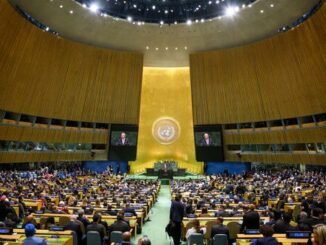
Can the UN still remain relevant if it still looks and acts like the organization it was when it was formed in 1945? The debate over UN reform at the General Assembly in New York last month produced a striking common refrain from a diverse range of Member States.
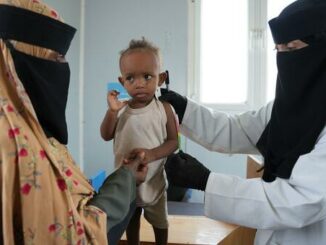
The World Health Organization (WHO) warned that significantly more resources are required to scale up its response in Yemen amid escalating conflict and rising needs.
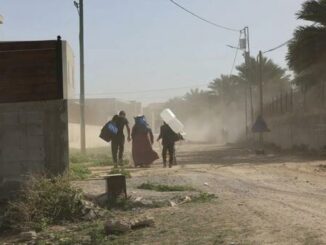
Sixty-nine Palestinians – more than half of them children – were displaced on Tuesday after Israeli authorities green lit the demolition of their residential building in the At Tur area of East Jerusalem, the UN aid coordination office (OCHA) has reported.
Child and adolescent obesity has quadrupled since 1990, rising from two per cent to around eight per cent of youngsters in the five-to-19 age group, according to the UN’s World Health Organization (WHO).