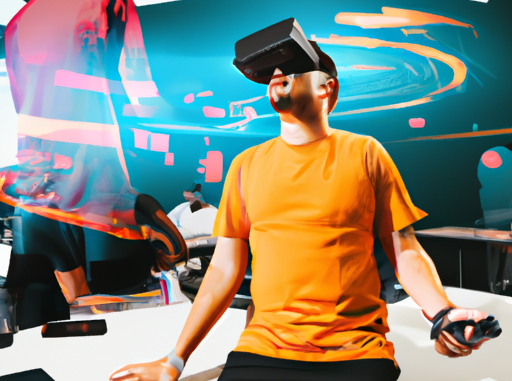
The Impact of Virtual Reality in Modern Education
Virtual Reality (VR) has significantly transformed various sectors, with education being one of the most promising fields. By offering immersive learning experiences, VR technology enhances student engagement and understanding across a wide range of subjects. This article explores the benefits, challenges, and future potential of incorporating VR into educational settings.
Benefits of VR in Education
One of the primary advantages of VR in education is the ability to create immersive learning environments that engage students more deeply than traditional methods. Virtual reality allows students to explore environments and scenarios that would be impossible or impractical in the real world. For example, history students can visit ancient civilizations, biology students can explore the human body in 3D, and chemistry students can conduct virtual experiments without harmful chemicals.
Moreover, VR promotes active learning, which is more effective than passive learning formats such as lectures. By actively participating in a VR simulation, students can experience and understand complex concepts through practical application. This hands-on experience can significantly improve retention and comprehension, making learning more effective and enjoyable.
Another significant benefit is accessibility. VR can bring high-quality education to remote or underserved areas where access to educational resources and experiences might be limited. With VR, students from all over the world can visit renowned museums, attend lectures by experts, and collaborate with peers without geographical constraints.
Challenges of Implementing VR in Education
Despite its potential, integrating VR into education is not without challenges. One of the main obstacles is the cost of VR equipment and software, which can be prohibitive for many educational institutions. While the prices for VR headsets and devices are gradually decreasing, they still represent a significant investment, especially for schools with tight budgets.
Another challenge is the lack of VR content tailored to educational purposes. Creating high-quality, curriculum-aligned VR content requires significant resources and expertise, which can be a barrier for widespread adoption. Additionally, educators need training to effectively integrate VR into their teaching methods, which requires time and investment.
Moreover, there are concerns about the physical effects of prolonged VR use, such as eye strain and motion sickness. These issues need to be addressed to ensure that VR can be used safely and effectively in educational settings.
Future Potential of VR in Education
The future of VR in education looks promising as technology continues to evolve. As costs decrease and content becomes more readily available, VR will likely become a more integral part of educational curricula. Advances in technology could lead to more realistic and engaging simulations, further enhancing the learning experience.
Furthermore, the development of social VR could enable more collaborative and interactive learning experiences. Students from around the world could come together in a virtual classroom, share perspectives, and work on projects collaboratively, fostering a global learning community.
In conclusion, VR holds the potential to revolutionize education by providing immersive, engaging, and accessible learning experiences. While there are challenges to overcome, the benefits make it an exciting area for ongoing research and development. As educators and technologists work together, VR could become a cornerstone of modern education, preparing students for the future in innovative and effective ways.
PhDr. Pavel Bartoš, LL.M., DBA (Evropská akademie vzdělávání / European Academy of education)
Leave a Reply